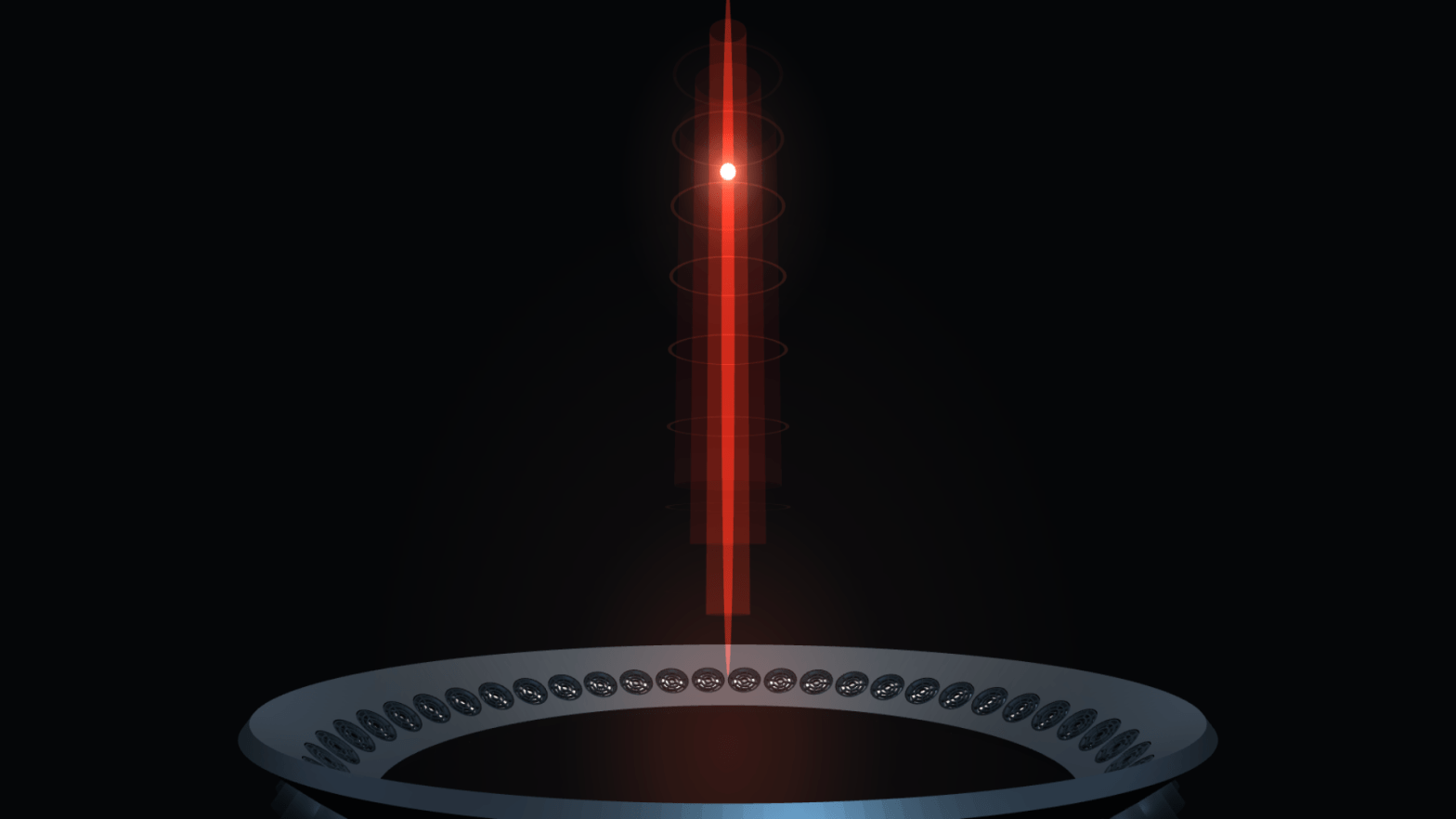
Acoustic levitation enables objects to be suspended and manipulated without physical contact, making it attractive for handling fragile components, contamination-sensitive samples, and objects that are difficult to grasp mechanically. However, most acoustic levitation systems either require sound sources surrounding the object or operate only within a relatively small region close to the transducers.
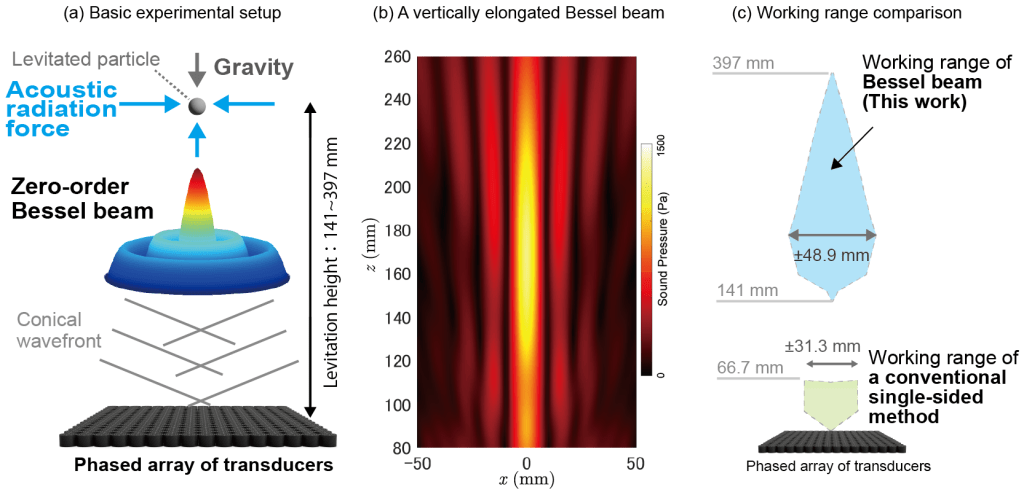
In our recent work, published in Physical Review Letters, we demonstrate a different approach. By trapping objects directly within the high-pressure core of a zero-order Bessel beam, we achieved stable three-dimensional levitation and manipulation at distances of up to approximately 40 cm from a single ultrasonic array—around six times the working distance of a conventional single-sided acoustic trap using the same hardware.
Why is long-range single-sided levitation difficult?
Conventional acoustic levitation most commonly relies on standing waves generated between opposing sound sources, or between a source and a reflector. Objects are typically confined around low-pressure regions where the acoustic radiation force provides restoring forces against displacement.
These configurations can provide highly stable trapping, but they also place hardware on multiple sides of the manipulation volume. For applications such as robotic manipulation, laboratory automation, scientific instrumentation, and interactive systems, it is preferable to leave the space surrounding the manipulated object as open as possible.
Single-sided acoustic levitation addresses this geometric constraint by creating a three-dimensional acoustic trap using sound arriving from only one direction. Existing techniques, including twin traps and acoustic vortices, can successfully levitate particles in this configuration. Their working distance, however, is generally limited: as the trap is moved farther from the transducer array, the restoring force weakens and eventually becomes insufficient for stable confinement.
The challenge is therefore not simply to generate more acoustic pressure. A useful long-range levitator must maintain a stable three-dimensional force distribution over a substantial propagation distance.
A different trapping principle: levitation in a high-pressure region
Our approach uses a zero-order Bessel beam.
Unlike a conventional focused beam, which concentrates acoustic energy around a relatively localized focal region, a Bessel beam forms a narrow central core that persists along the propagation direction. This produces an extended region of high acoustic pressure.
The more unusual aspect of the approach is where the particle is trapped.
Most established acoustic levitation techniques deliberately create low-pressure regions in which particles can be confined. Here, the particle instead occupies the high-pressure core of the Bessel beam.
At first sight, this appears counterintuitive. The radiation-force distribution generated by the Bessel beam, however, provides transverse restoring forces that return the particle toward the beam axis, while the axial acoustic force balances gravity. The result is a stable three-dimensional trap located directly within the region of high acoustic pressure.
Although levitation within a high-pressure region had previously been predicted theoretically, stable three-dimensional mid-air levitation under these conditions had not been experimentally demonstrated. Our experiments establish this trapping regime using a 40-kHz ultrasonic phased array.
Extending the manipulation range to nearly 40 cm
The immediate consequence of this trapping mechanism is a substantially larger working distance.
Using a 16 × 16 ultrasonic phased array, we stably levitated a 1.5-mm-diameter expanded-polystyrene particle between approximately 141 and 397 mm above the array. By comparison, a conventional single-sided twin trap generated using the same hardware reached approximately 66.7 mm.
The maximum levitation distance therefore approaches 40 cm, corresponding to approximately six times the working distance of the conventional single-sided configuration.
Importantly, the result is not limited to static levitation. The Bessel beam can be controlled electronically through the phased array. Steering the beam produces horizontal particle motion, while modifying the field along the propagation direction enables vertical translation. We therefore demonstrated three-dimensional manipulation throughout an extended open volume above the array.
The distinction between levitation distance and manipulation range is important. Simply suspending an object at a large distance would have limited practical value. Here, the extended Bessel-beam region instead forms a controllable three-dimensional workspace.
Levitation beyond an obstacle
Bessel beams also exhibit another useful characteristic: their central field can reconstruct after partial obstruction.
The beam is formed by acoustic contributions propagating toward the central axis from different directions. Consequently, blocking part of the field can strongly disturb the beam immediately behind an obstacle while still allowing its central structure to reform farther downstream.
We used this property to demonstrate levitation beyond a physical obstacle.
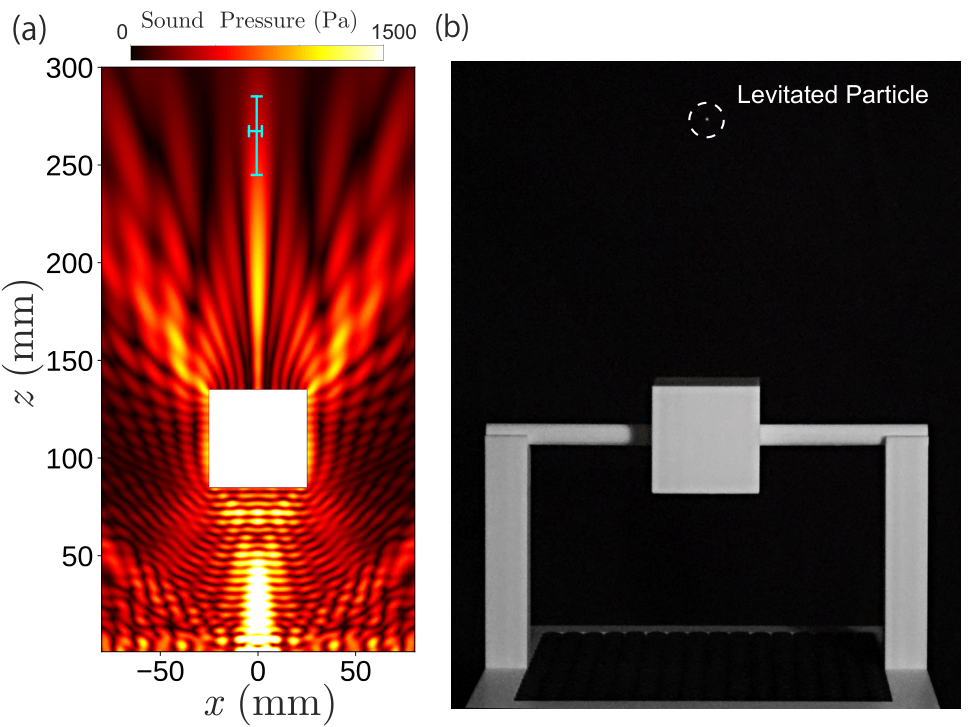
A solid object was inserted between the ultrasonic array and the levitated particle. Simulations show the acoustic field being disrupted behind the obstruction and subsequently reconstructing. Experimentally, a particle could remain stably levitated above the obstacle.
This capability is particularly relevant to the broader objective of open acoustic manipulation. Real environments do not necessarily provide an unobstructed propagation path: experimental apparatus, components, or other manipulated objects may occupy part of the acoustic field. The ability of the trapping field to recover after obstruction therefore provides an additional degree of geometric flexibility.
Reconsidering how acoustic traps are designed
The significance of this work is not simply the maximum distance of 397 mm.
Most established acoustic levitation approaches begin by designing a low-pressure region in which an object can be confined. Our results demonstrate experimentally that stable three-dimensional levitation can instead be achieved within an extended high-pressure region.
Changing the trapping principle consequently changes the geometry of the system. Rather than creating a localized trap close to the array, the Bessel beam produces an extended manipulation region that can be accessed from only one side.
Such an open configuration could ultimately be useful for contactless materials handling, laboratory automation, scientific experimentation, and three-dimensional display technologies.
Important challenges remain, including increasing manipulation speed and payload, improving robustness to disturbances, and introducing more precise closed-loop control. Nevertheless, the present work establishes a distinct operating regime for mid-air acoustic manipulation.
Rather than asking only how far an existing acoustic trap can be extended, the result suggests a different design question: what becomes possible if we reconsider where, within the acoustic field, an object should be trapped?
Y. Koroyasu, C. Stone, Y. Ochiai, T. Hoshi, B. W. Drinkwater, and T. Fushimi, “Midair Single-Sided Acoustic Levitation in High-Pressure Regions of Zero-Order Bessel Beams,” Physical Review Letters 137, 094001 (2026). https://doi.org/10.1103/pfkh-4x7j

